 Agent
Agent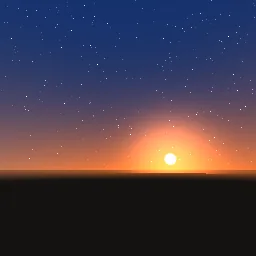
What this component contains
ATTRIBUTION.mdLICENSEREADME.mdcomponent.jsondemo.tscninspect_shader.pymaterial.trespreview.pngsky_day_night_cycle.gdshadertest_package.pyverification/native.json
How it works
- Shader type
- sky
- Parameters
- day_zenith (vec4 = 0.16, 0.38, 0.82, 1), day_horizon (vec4 = 0.62, 0.78, 0.95, 1), sunset_glow (vec4 = 1, 0.48, 0.2, 1), night_zenith (vec4 = 0.01, 0.015, 0.05, 1), night_horizon (vec4 = 0.05, 0.07, 0.16, 1), ground_color (vec4 = 0.16, 0.15, 0.14, 1), horizon_falloff (float = 3), sun_size (float = 0.03) and 3 more
- Use it on
- A DirectionalLight3D in the scene. Its direction is the sun; without one the sun sits at a fixed low angle.
- Result
- A gradient sky with a sun and halo that changes from day blue through an orange sunset to a starry night as the light's elevation changes.
- Renderers
- compatibility: compiled and rendered, forward plus: not verified, mobile: not verified
- Placement
- res://baltor/godot_shaders/sky_day_night_cycle/
Recorded checks
godot 4.7.2.stable.official.ed1daf0bf
contract_staticengine_runengine_log_cleanshader_in_scenecapture_writtenrender_not_uniformshader_changes_pixels
Limits to consider
Stylized, not a physical atmosphere: colours come from the uniforms, not from scattering. Stars are point-like only at moderate field of view; at very wide angles grid cells can show. Only the first directional light is read. Sky radiance for reflections updates with Godot's sky process mode.