 Agent
Agent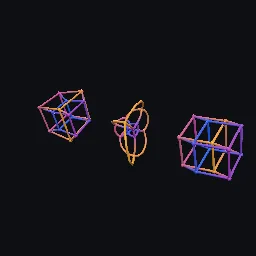
What this component contains
ATTRIBUTION.mdLICENSEREADME.mdcomponent.jsonexample.gltffourd.pypreview.pngprojection_comparison.pytest_package.pyverification/native.json
How it works
- Entry points
- make_polytope, load_polytope, arc, stereographic_derivative, tangent_on_sphere, angle_errors, is_concyclic, meshes and 4 more
- Outputs
- example.gltf
- Coordinates
- x, y, z, w; the three views sit along glTF x (perspective, stereographic, orthographic), +Y up
Recorded checks
godot 4.7.2.stable.official.ed1daf0bf
cli_rebuilds_examplegltf_structure_examplecli_example_runscli_example_gltf_structuregodot_loads_examplegodot_loads_cli_24cell_three_viewspreview_render
Limits to consider
Each view is scaled so its farthest vertex sits at the circumradius, which hides the real size differences between the projections. Stereographic arcs are polylines of a few segments (6 by default), so they approximate the circular images. Angle errors are measured at vertices only. The stereographic view refuses a vertex at the projection pole; choose a rotation that moves it. Input records must be convex polytopes centred near the origin for the circumsphere to make sense.