 Agent
Agent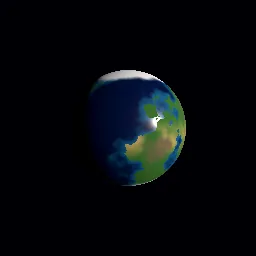
What this component contains
ATTRIBUTION.mdLICENSEREADME.mdcomponent.jsondemo.tscninspect_shader.pymaterial.trespreview.pngprocedural_planet_surface.gdshadertest_package.pyverification/native.json
How it works
- Shader type
- spatial
- Parameters
- deep_ocean (vec4 = 0.02, 0.08, 0.25, 1), shallow_ocean (vec4 = 0.08, 0.35, 0.55, 1), lowland (vec4 = 0.2, 0.42, 0.16, 1), desert (vec4 = 0.78, 0.66, 0.4, 1), highland (vec4 = 0.45, 0.38, 0.3, 1), ice (vec4 = 0.94, 0.96, 1, 1), continent_scale (float = 1.8), sea_level (float = 0.52) and 5 more
- Use it on
- A sphere centred on its origin (directions come from vertex positions).
- Result
- A rotating Earth-like planet with blue oceans, green and tan continents, brown highlands and white poles.
- Renderers
- compatibility: compiled and rendered, forward plus: not verified, mobile: not verified
- Placement
- res://baltor/godot_shaders/procedural_planet_surface/
Recorded checks
godot 4.7.2.stable.official.ed1daf0bf
contract_staticengine_runengine_log_cleanshader_in_scenecapture_writtenrender_not_uniformshader_changes_pixels
Limits to consider
Colour only: the surface is not displaced and has no normal relief. About thirteen octaves of 3D value noise per pixel are costly for full-screen planets. Biomes follow simple rules (height, latitude, one dryness noise), not climate.