 Agent
Agent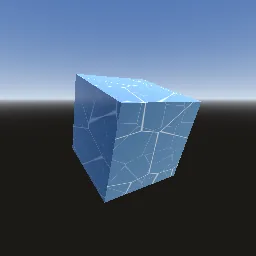
What this component contains
ATTRIBUTION.mdLICENSEREADME.mdcomponent.jsondemo.tscnice_crack_voronoi.gdshaderinspect_shader.pymaterial.trespreview.pngtest_package.pyverification/native.json
How it works
- Shader type
- spatial
- Parameters
- ice_color (vec4 = 0.62, 0.82, 0.95, 1), deep_color (vec4 = 0.12, 0.32, 0.58, 1), crack_color (vec4 = 0.95, 0.98, 1, 1), cell_scale (float = 5), crack_width (float = 0.035), inner_depth (float = 0.15), inner_strength (float = 0.55), frost_rim (float = 1.2) and 1 more
- Use it on
- A mesh with UVs and tangents (Godot primitive meshes have both).
- Result
- Pale blue ice with bright fracture lines on top and fainter fractures that shift inside as you move.
- Renderers
- compatibility: compiled and rendered, forward plus: not verified, mobile: not verified
- Placement
- res://baltor/godot_shaders/ice_crack_voronoi/
Recorded checks
godot 4.7.2.stable.official.ed1daf0bf
contract_staticengine_runengine_log_cleanshader_in_scenecapture_writtenrender_not_uniformshader_changes_pixels
Limits to consider
The inner layer is a single parallax offset, not refraction or real volume; at grazing angles it smears. Not transparent; objects behind the ice are not visible. Crack density follows the mesh UVs, so stretched UVs give stretched cells.